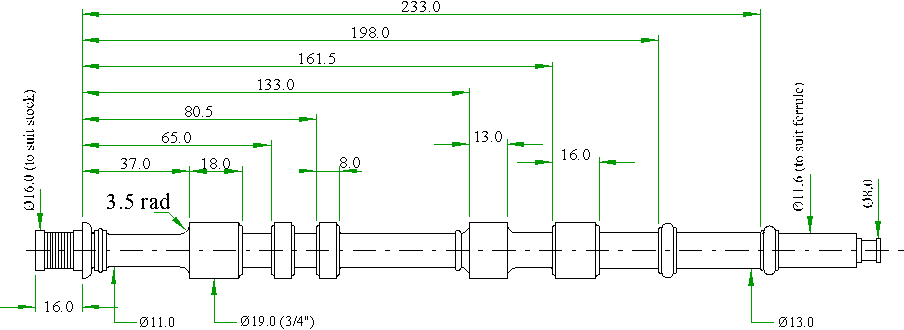
The wood should be cut to length being sure to keep the ends as square as possible. The centre point of each end is then found, centre punched and centre drilled using a No. 2
'Slocombe' centre drill. The blank is mounted between centres in the lathe, and turned to the largest cylinder possible. This should be at least 3mm larger than the final diameter and more if possible. If you have a four-jaw chuck, the blank can be mounted in its square condition and the bore drilled before the outside is turned. However I have found that this is not necessary if the drilled hole is well centred and the wood of sufficient size to turn to an outside diameter of 22/25mm. The larger the diameter the more the bore of the chanter can be allowed to drift out of alignment during the drilling before the blank is ruined.
Drilling the bore
The blank is gripped in a three-jaw chuck. The free end is checked to ensure that the centre drilled hole is running centrally. If it is more than a tiny amount off centre, adjust the mounting in the chuck until any visible excentricity is corrected. When the blank is running centrally, drill a pilot hole EXACTLY on the centre which is the same diameter as the bore of the chanter (Ø4.0mm). This pilot hole is drilled about 12mm/15mm deep. It is VITAL that this hole is as accurate as possible as any errors here will be amplified during the drilling of the rest of the bore. A technique that I use to ensure a central hole is to follow the centre drill with a Ø3.5mm drill and then open it out to size using a good Ø4.0mm slot drill gripped in the tailstock chuck. A further trick is to place a piece of paper under one of the jaws of the tailstock chuck. This will push the Ø4.0mm slot drill enough off centre to ensure that only one of its cutting edges is active, thus acting as a very stiff single point boring tool and reducing any chance of the pilot hole wandering off centre.
The 'D' bit drill is held in a tap wrench and guided into the prepared hole by hand. This does does take some care to ensure that the initial accuracy is not compromised. If the lathe used is one of the older types of lathe with a 'through hole' tailstock, eg:- the early Myford® ML7, a bush can be put in this hole and the drill guided through this into the wood. This will make the first 50mm to 100mm easier after which the tailstock can be removed and the remaining drilling completed freehand. If the lathe used does not have a through hole, a guide can be made and fitted to the lathe bed. However, care must be taken to ensure that it can be fitted and dismounted whilst maintaining its accuracy.
The lathe should be run at about 600 R.P.M. and the drill fed gently into the wood using only a light hand pressure. The cutting should proceed in steps of about 2 or 3mm. After each step the drill must be removed from the hole and the plug of swarf flicked off the end. The swarf should fill only about 3/4 of the space on the flat of the 'D' If the space is filled completely the amount that the drill is advanced each step should be reduced as there is a danger of the hole either being forced off-centre or a chamber being created. As the drilling proceeds the drill may start to bind in the hole. This can be eased by rubbing the drill on a block of beeswax.
If the friction becomes too great it is an indication that the hole being drilled is slightly smalled than the shank of the drill. I have had some success in relieving this by rubbing the shank of the drill with emery paper thus slightly reducing its diameter.
Another common problem is difficulty in extracting the plug of swarf. This is caused either by the swarf holding feature on the drill being too shallow to hold the plug of swarf securely, or the hole is not being advanced sufficiently at each step to create a plug packed down into the holding feature. This problem can also be caused by the drill cutting undersize causing the plug to be pulled off the drill by friction. The solution to this is to run a 'D' bit reamer the same nominal size as the drill into the hole thus increasing the bore diameter very slightly and allowing the plug easy passage out of the bore.
I aim to have a runout of less than 1mm in the length of the chanter and have often achieved half of this. I cannot stress strongly enough that the straightness of the final bore is established in the first 12mm of the drilling and time spent getting this right will be rewarded with a good bore that will make the chanter easier to tune and play.
I would recommend starting the drilling with the shortest drone and progressing up through the lengths. This will allow enough practice to enable the chanter bore to be drilled with a greater degree of confidence.
Finishing the Bore
Once the bore has been drilled to Ø4.0mm it is necessary to ream the bore to its final diameter of Ø4.3mm (11/64"). To do this I have increased the length of an 11/64" hand reamer.
To extend the length of the hand reamer I turn down the square socket on the end to about Ø2.5mm. it is usually possible to do this as the end of the reamer is usually left soft. If it is hard it can be softened by heating just the square end up to red heat and allowing it to cool as slowly as possible (withdraw it from the flame very slowly. This should leave it soft enough to turn down in the lathe.
Drill a hole to fit the turned down part of the reamer in a length of Ø4mm silver steel, long enough to ensure that the reamer goes all the way through the chanter and silver solder together making sure that the 2 parts are concentric and parallel.
I have found that it is necessary to remove the reamer from the bore several times and clear out the swarf using the Ømm drill. You should find that the resulting bore is accurate and highly polished.
The reed socket
There are a number of different ways and shapes of reed socket. The traditional version is a taper starting off at about Ø8mm and tapering to the long bore diameter a couple of mm before the top of the "b" hole. My preferred version is a parallel hole of about Ø6.3mm (1/4") finishing at the end of the tennon as shown on the drawings.. I will try to explain the reason for the different styles:-
The tapered version: This aims to have no "edge" to disrupt the movement of the air column where the end of the reed joins the bore. The limitation that this creates is that the reed needs to be re-wrapped to change its position and this can be a bit of a chore.
The parallel version: This does have a distinct edge where the socket joins the bore. I have done some experimenting to see if I can detect any difference caused by this - I made a series of rings to fill the gap between the bottom of the reed and the start of the chanter bore - but I haven't found any change in tone between fitted and non-fitted so I continue to use the parallel socket as the real benefit is that the reed can be slid in and out easily and quickly thus making the tuning of the chanter much easier to control.
I make the socket using a Ø1/4" counterbore tool that has a central pin which ensures that the socket is concentric with the bore. I hold the counterbore in the chuck of the lathe with only enough sticking out to cut to the depth required. I have a Ø4.2 drill mounted in the tailstock of the lathe. The bottom of the chanter is slid onto the tailstock drill and the tailstock moved towards the chuck until the pin of the counterbore is just entered into the chanter bore. I then start the lathe and with the chanter held, I apply pressure to cause the countersink to cut the socket. I continue cutting until the chanter tenon reaches the chuck jaws.
Turning the chanter
The drilled blank is mounted between centres and turned to a diameter of 19mm (3/4"). It will save time later if you take care to get as good a finish as possible. Mark the ring positions on the blank from the drawings taking care to identify clearly those areas to be turned away.